
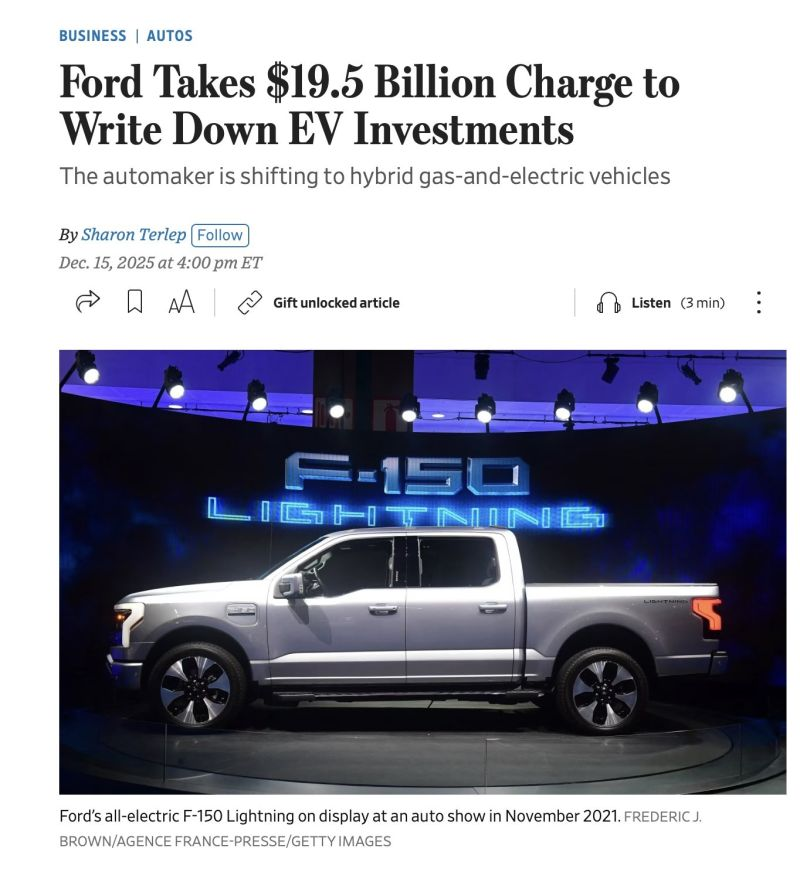
Ford takes a $19.5 billion hit to write down its EV investments
Executive Summary
Ford has announced approximately $19.5 billion in special charges as part of a comprehensive overhaul of its EV strategy, representing one of the largest write-downs in recent automotive industry history. This significant move responds to softer-than-expected EV consumer demand, a more challenging U.S. policy environment, and mounting financial losses within the Model e division.
Why This Matters
This strategic reset demonstrates how legacy automakers are recalibrating their EV plans away from a “land grab at any cost” mentality toward more disciplined capital deployment. Rather than chasing unprofitable volume in an effort to claim market share, Ford is pivoting toward hybrids, profitable truck and commercial van segments, and smaller, lower-cost EVs where the company sees clearer paths to positive unit economics and sustainable profitability.
Key Insights
Financial Structure: Approximately $8.5 billion of the total charge relates to canceling several large EV programs, while roughly $6 billion is associated with ending the SK On battery joint venture, and about $5 billion covers other related impairments.
Cash Flow Impact: Management expects only about $5.5 billion of the total charge to actually impact cash flow between 2026 and 2027, and has raised its 2025 EBIT outlook to approximately $7 billion as the restructured plan begins to take effect.
Strategic Pivot: Ford will repurpose significant portions of its battery manufacturing footprint to support a new energy-storage business serving data centers and electrical grid applications, while simultaneously targeting development of a next generation of smaller, more affordable EVs, including a mid-size electric pickup truck planned for around 2027.
Our Perspective
Despite sensational headlines characterizing this as “Detroit’s biggest EV bust,” the strategic pivot appears far more like a pragmatic market reset than a wholesale EV retreat. Ford still aims for hybrids, range-extended EVs, and battery-electric vehicles to collectively comprise approximately half of global sales by 2030—clearly signaling continued commitment to long-term electrification even as the near-term product mix thoughtfully shifts to include more hybrids and commercial vehicle applications. This is the kind of difficult but necessary recalibration that mature companies make when market conditions evolve differently than initial projections suggested. For investors and industry observers, it’s important to distinguish between a company abandoning a strategy entirely versus a company adapting that strategy to align with current market realities while maintaining its long-term vision.