
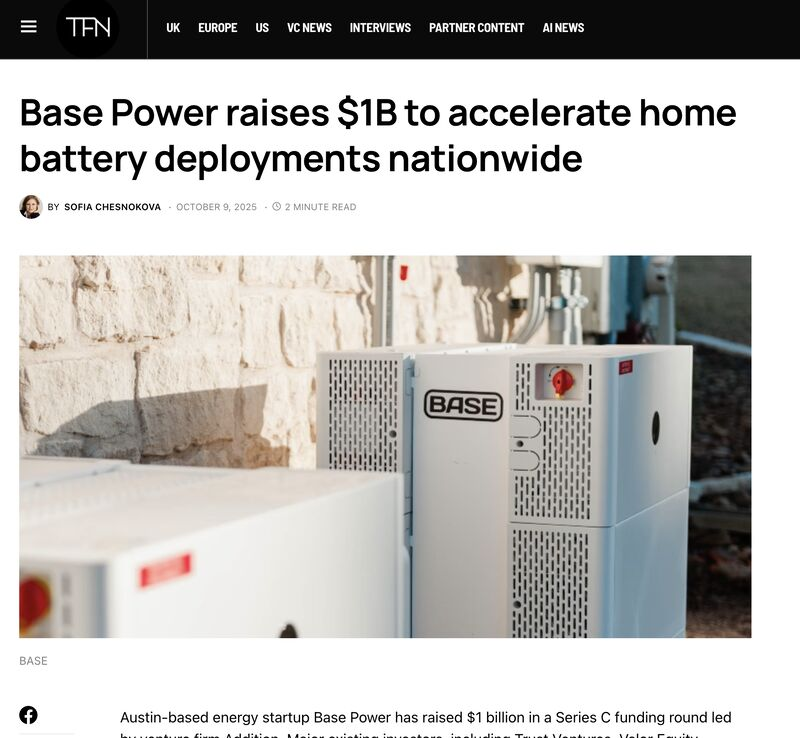
Base Power raises $1B to turn homes into a nationwide battery network.
ExecSum
Base Power raised $1 billion in Series C, which is the largest round ever for residential energy infrastructure. This isn’t just a funding milestone. It’s institutional capital finally recognizing home batteries as grid infrastructure, rather than consumer hardware.
Why this matters
For a decade, home batteries were a homeowner problem: backup power, bill reduction, maybe some environmental goodness. Base Power is solving a grid problem using home batteries. That’s the inversion that changes everything.
The grid is under stress. AI data centers are pulling power unpredictably. Renewable generation is intermittent. Peak demand is sharper. Utilities need flexible capacity fast, but building new infrastructure takes years and billions. Base Power’s answer: aggregate 100,000 distributed batteries into a single responsive asset the grid can actually use.
Home batteries suddenly become infrastructure. And infrastructure gets institutional money.
Key insights
The scale is unprecedented. This round is 20x larger than typical climate tech funding because the addressable market is different. Investors aren’t betting on a product category. They’re betting on 160 million US homes becoming grid operators.
The business model works for everyone. Homeowners get paid for stored energy they weren’t using anyway. Utilities avoid capex on new generation. The grid gets stability without subsidies or policy dependence. That alignment is rare in climate tech.
This sets a new floor. When CapitalG, a16z, Addition, and Lowercarbon move capital this size into distributed energy, incumbents have to respond. Expect utilities to build their own aggregation platforms. Expect hardware makers to redesign for grid integration. Expect competition.
Our take
The energy transition isn’t coming from the top down anymore—it’s coming from 100,000 homes with batteries. This deal signals that the infrastructure layer of the grid is decentralizing, and investors are betting on the edge winning.
What happens next isn’t about technology. It’s about who owns the relationship with the homeowner and who controls the aggregation layer. That battle will define the next decade of energy infrastructure.